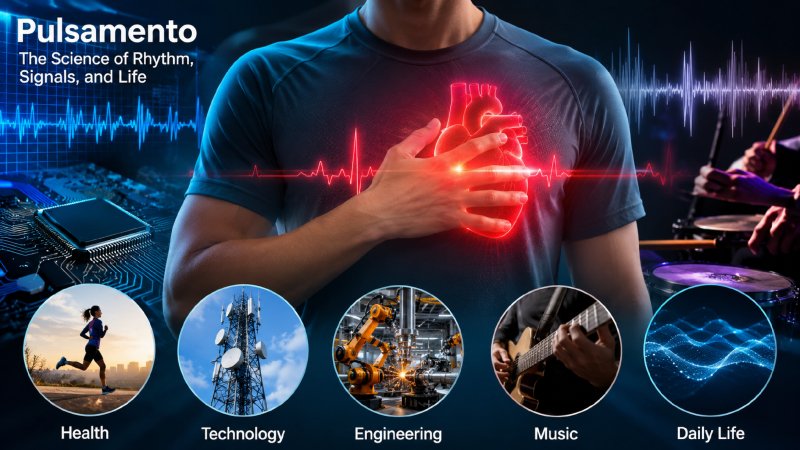
Have you recently come across the term Pulsamento and wondered what it actually means? You are not alone. The word has started appearing across health blogs, technology discussions, engineering resources, and music-related content, leaving many readers confused about its true purpose.
Unlike common technical or medical terminology, this term does not have one universally accepted definition. Instead, it is used to describe the idea of rhythm, recurring motion, repeated signals, or steady patterns found in both natural and artificial systems. Depending on the context, it may refer to the human heartbeat, musical timing, electronic pulse signals, or mechanical vibrations.
Understanding this concept is valuable because rhythm exists almost everywhere. From the beating of your heart to the digital devices you use every day, repeating patterns help systems remain organized, efficient, and reliable.
This guide explains the meaning, practical applications, advantages, limitations, and best practices in simple language. Whether you are researching the topic for personal knowledge, education, or professional purposes, this article provides a balanced explanation without unnecessary complexity.
What Does Pulsamento Mean?
At its simplest, the term refers to a recurring Pulsamento, rhythm, vibration, or repeated movement that follows a recognizable pattern. Rather than describing a specific object or technology, it represents a principle that appears in many areas of life.
Examples include:
- A steady heartbeat pumping blood through the body.
- The rhythm of breathing during relaxation.
- Electrical pulses traveling through communication systems.
- Repetitive movement inside industrial machines.
- Musical beats that keep performers synchronized.
Although the word is often associated with health-related discussions, its broader meaning extends far beyond medicine. It represents consistency, timing, and repetition—the building blocks of countless natural and technological processes.
Why Is This Concept Becoming More Popular?
The growing interest comes from increased public awareness of health monitoring, wearable technology, automation, and digital communication.
Modern smart devices continuously measure patterns such as the following:
- Heart rate
- Sleep cycles
- Physical activity
- Signal transmission
- Machine performance
As these technologies become part of everyday life, people naturally become curious about the rhythmic systems operating behind them.
At the same time, musicians, engineers, software developers, and healthcare professionals all use similar ideas when discussing timing, synchronization, and repeating patterns. This broad relevance has increased online searches for the term.
The Core Principle Behind Repeating Rhythms
Nearly every system depends on predictable repetition.
Think about daily life:
- The sun rises every morning.
- Your heart beats continuously.
- Breathing follows an inhaling and exhaling cycle.
- Computer processors execute millions of timed operations every second.
- Music relies on tempo to maintain harmony.
Without repetition, systems become unstable.
This principle explains why rhythm plays such an important role in biology, engineering, technology, and even creative arts.
Major Applications Across Different Fields
Health and Human Biology
The human body is built around carefully regulated rhythms.
Some of the most familiar examples include the following:
- Heartbeat
- Blood circulation
- Breathing
- Sleep cycles
- Hormone release
Doctors often evaluate these natural patterns because sudden changes may indicate that something requires further examination.
However, it is important to understand that this term itself is not an official medical diagnosis. Healthcare professionals use established medical terms such as pulse, heart rate, cardiac rhythm, or palpitations when assessing patients.
Technology and Digital Systems
Modern technology relies heavily on precisely timed electrical signals.
Examples include:
- Computer processors
- Mobile communication
- Internet infrastructure
- Wireless networks
- Data synchronization
Every digital instruction depends on accurate timing. Even tiny interruptions can affect system performance.
For this reason, recurring electronic signals are essential for maintaining reliable communication between devices.
Engineering and Industrial Systems
Mechanical equipment also operates through repeating movements.
Examples include:
- Pumps
- Motors
- Compressors
- Turbines
- Manufacturing equipment
Engineers continuously monitor these rhythmic movements because unusual vibration patterns may indicate wear, imbalance, or developing mechanical faults.
Early detection helps reduce maintenance costs while preventing unexpected equipment failures.
Music and Creative Expression
Music may be the easiest place to understand this idea.
Every song contains:
- Beat
- Tempo
- Timing
- Rhythm
These elements allow performers to remain synchronized throughout a performance.
Professional musicians often adjust rhythm slightly to create emotional expression without losing the overall structure of the composition. This subtle control makes performances feel more natural and engaging.
Comparison Table
| Area | How Rhythm Is Used | Practical Purpose |
|---|---|---|
| Health | Heartbeat and breathing | Monitor body function |
| Technology | Digital pulse signals | Transfer information accurately |
| Engineering | Mechanical vibration | Improve reliability and maintenance |
| Music | Beat and tempo | Maintain timing and expression |
| Daily Life | Natural recurring patterns | Create consistency and organization |
This comparison highlights how the same fundamental idea appears across completely different disciplines.
Key Benefits
Understanding rhythmic systems provides practical advantages for both individuals and professionals.
Some important benefits include:
- Improves awareness of natural body functions.
- Helps engineers identify equipment problems early.
- Supports reliable communication between electronic devices.
- Enhances musical timing and performance.
- Makes data analysis more accurate.
- Encourages better understanding of recurring patterns in everyday life.
These advantages explain why the concept remains valuable across multiple industries rather than belonging to a single field.
Common Misunderstandings
Many online articles create unnecessary confusion by presenting the topic as something mysterious or exclusive to one discipline.
In reality, most misunderstandings come from assuming the word always refers to the same subject.
Here are some common misconceptions:
It Is a Medical Condition
No. Although it is often discussed alongside heart rhythm, it is not recognized as an official medical diagnosis.
It Only Relates to Music
Not at all. Music is only one application. Similar rhythmic principles appear in biology, electronics, engineering, communication systems, and environmental science.
It Is a New Technology
The underlying concept has existed for centuries. Modern technology simply applies rhythmic patterns in more advanced ways.
It Has One Universal Meaning
Its interpretation depends on the surrounding context, making it a flexible rather than fixed term.
Why Context Matters
One reason people become confused is that the same word may describe different ideas depending on where it appears.
For example:
- A healthcare article may discuss heartbeat and circulation.
- A technology website may explain digital signal timing.
- A music publication may focus on rhythm and tempo.
- An engineering guide may examine machine vibrations.
Instead of looking for a single definition, it is more helpful to understand the common principle shared by all these examples: consistent, measurable repetition.
Warning Signs to Watch For
While rhythm and repeated patterns are normal in many systems, sudden or unusual changes should never be ignored—especially when they involve your health or critical equipment.
For Individual Users
Seek professional advice if you notice:
- Persistent irregular heartbeat or Pulsamento
- Chest pain or pressure
- Severe dizziness or fainting
- Shortness of breath without a clear reason
- A rapid heartbeat while resting
- Repeated symptoms that continue or worsen over time
These signs may indicate an underlying medical condition that requires proper evaluation. Avoid relying solely on online information if symptoms are severe or persistent.
For Technical Systems
Watch for these warning indicators:
- Unexpected vibration levels
- Irregular operating cycles
- Signal interruptions or communication delays
- Unusual equipment noise
- Sudden drops in performance
- Repeated system errors or unexpected shutdowns
Early inspection can help prevent costly failures and improve long-term reliability.
Pros and Cons
Understanding rhythmic systems offers many advantages, but it also has certain limitations.
Pros
- Improves understanding of natural and mechanical processes.
- Supports preventive maintenance in engineering.
- Helps identify unusual health or equipment patterns.
- Enhances musical timing and performance.
- Encourages better data monitoring and analysis.
- Applies across multiple industries and disciplines.
Cons
- The term is not universally defined.
- Different industries use it in different ways.
- It may confuse readers expecting one specific meaning.
- Online information can sometimes be inaccurate or misleading.
- Observing a pattern alone does not provide a complete diagnosis or technical assessment.
Best Practices
For Individual Users
Following a few simple habits can help you better understand natural rhythms without creating unnecessary concern.
- Learn your normal resting heart rate.
- Maintain regular physical activity.
- Stay hydrated throughout the day.
- Get consistent, quality sleep.
- Limit excessive caffeine if it noticeably affects your heartbeat.
- Use wearable health devices only as monitoring tools, not as replacements for medical advice.
- Consult a healthcare professional whenever symptoms appear unusual.
These habits promote awareness while supporting overall well-being.
For Technical Teams
Professionals working with electronic or mechanical systems should adopt a proactive approach.
- Monitor system performance regularly.
- Calibrate sensors according to manufacturer recommendations.
- Record performance trends for future analysis.
- Investigate abnormal vibration or signal patterns promptly.
- Perform scheduled preventive maintenance.
- Combine automated monitoring with manual inspections.
- Document recurring issues to improve long-term system reliability.
Consistent monitoring helps reduce downtime and improves operational efficiency.
Practical Examples in Everyday Life
Rhythmic patterns are easier to recognize than many people realize.
Consider these everyday examples:
- Feeling your heartbeat after climbing stairs.
- Watching ocean waves move toward the shore.
- Following the beat while listening to your favorite song.
- Observing traffic lights changing in a predictable sequence.
- Seeing factory equipment repeat identical production cycles.
- Using a smartwatch to monitor daily activity and heart rate.
- Noticing your breathing naturally slow during relaxation.
Each example demonstrates how recurring patterns help create stability and organization.
Why Understanding Context Is Important
Because this concept appears in multiple fields, readers should always consider the surrounding context before drawing conclusions.
For example:
- A health article focuses on heartbeat, breathing, and circulation.
- A technology guide discusses electrical timing and communication signals.
- An engineering manual examines machine performance.
- A music lesson explains rhythm, tempo, and expression.
Recognizing the intended context prevents misunderstandings and allows information to be applied correctly.
Frequently Asked Questions
1. Is Pulsamento an official medical diagnosis?
No. It is not recognized as a standard medical diagnosis. Healthcare professionals use specific medical terms such as Pulsamento, heart rate, rhythm, or palpitations when evaluating patients.
2. Can this concept be applied outside healthcare?
Yes. It is widely associated with engineering, electronics, music, communication systems, and scientific research because all these fields rely on recurring patterns and timing.
3. Why do different websites explain it differently?
The word is used in multiple contexts rather than representing one fixed definition. Understanding the subject of the discussion helps clarify its intended meaning.
4. How can I observe rhythmic patterns in daily life?
You can notice them through your heartbeat, breathing, walking pace, musical beats, digital devices, and even natural cycles such as day and night.
5. Should I worry if my heartbeat feels different?
Not every change is serious. Exercise, stress, excitement, and caffeine can temporarily affect your heart rate. However, persistent irregular heartbeat, chest pain, fainting, or severe shortness of breath should always be evaluated by a qualified healthcare professional.
6. Why is rhythm important in technology?
Modern electronic systems depend on accurate timing to process information, synchronize devices, and maintain reliable communication. Even minor timing errors can affect overall performance.
Conclusion
Understanding Pulsamento becomes much easier when viewed as the principle of rhythm, recurring movement, and consistent patterns rather than a single definition. Whether discussing the human body, engineering systems, digital communication, music, or everyday life, the same underlying concept connects them all through predictable repetition.
Recognizing these patterns can improve awareness, support better decision-making, and help identify changes that deserve closer attention. At the same time, it is important to remember that general information should never replace expert advice. If you experience unusual health symptoms or detect abnormal behavior in important technical systems, seek guidance from a qualified healthcare or technical professional. Using knowledge responsibly is the safest and most effective way to benefit from this concept.